

In an era of fluctuating shipping costs and unpredictable consumer behavior, data is the only compass that works. Mastering inventory control is no longer a “back-office” task it is a strategic advantage. Whether you are dealing with inventory positioning in a global network or trying to reduce inventory aging in a single warehouse, the principles remain the same.
In this guide, we will move beyond basic counting. We will explore how inventory analytics can turn raw numbers into profit, how to implement professional-grade Cycle Counting, and which KPIs actually move the needle for your bottom line.
Why Inventory Control is the Lifeblood of Your Business

Why should a business care about the granular details of their stock? The answer lies in the thin line between profitability and bankruptcy. Effective inventory control isn’t just about “organization” it’s about liquidity.
The Financial Impact: Cash is King
Every item sitting in your warehouse represents a “carrying cost.” These costs include insurance, taxes, warehouse rent, and the risk of obsolescence. Industry data suggests that carrying costs can range from 20% to 30% of your total inventory value annually.
- Preventing “Dead Stock”: Without tight control, items can sit until they become unsellable. Monitoring Inventory Aging helps you identify these slow-moving items before they lose their value entirely.
- Freeing Up Working Capital: By maintaining leaner stock levels through better control, you free up cash that can be reinvested into marketing, R&D, or expanding your product line.
Operational Excellence and Customer Trust
Inventory control is the silent engine behind customer satisfaction. In the age of “next-day delivery,” a single error in stock count can lead to a “backorder” email that drives a customer straight to your competitor.
- Eliminating Stockouts: Real-time visibility ensures you never promise a product you don’t actually have on the shelf.
- Optimizing Labor Productivity: When your inventory is controlled and well-positioned, warehouse staff spend less time searching for items and more time shipping them. This is where Inventory Positioning in Supply Chain Management becomes vital placing the right goods in the right location to minimize travel time.
The Risk of “The Guesswork Gap”
Businesses that rely on “gut feelings” or outdated spreadsheets often fall victim to the “Bullwhip Effect.” This is where small fluctuations in retail demand cause massive, expensive ripples of overstocking further up the supply chain. Systematic control acts as a shock absorber, ensuring your data reflects reality, not assumptions.
Best Practices: Transforming Your Warehouse into a High-Efficiency Hub

Implementing a strategy is one thing; maintaining it daily is another. To achieve “gold standard” status in inventory control, you must move away from reactive fixes and toward proactive habits. These industry-vetted best practices are what separate market leaders from struggling businesses.
Prioritize Cycle Counting Over Annual Audits
For decades, businesses closed their doors for three days at the end of the year to perform a “Wall-to-Wall” physical count. This is outdated, expensive, and prone to human error. Modern leaders use Inventory Cycle Counting.
Instead of one massive, exhausting audit, you count a small subset of your inventory every single day. By focusing on your high-value items more frequently, you catch discrepancies immediately. This ensures your digital records match your physical shelves nearly 100% of the time, without ever pausing your operations or losing a day of sales.
Optimize with Strategic “Slotting”
Where you put an item matters just as much as how many you have. This is a core component of Inventory Positioning in Supply Chain Management. Think of it like a professional kitchen: the tools you use most are within arm’s reach.
- Velocity-Based Slotting: Place your “fast-movers” (the items that sell every day) near the packing stations. This minimizes the distance warehouse pickers have to walk.
- Ergonomic Safety: Heavier items should be stored at waist level to prevent injury, while lighter, slow-moving items can go on higher or harder-to-reach racks.
Standardize Your Receiving Process
Errors in inventory control usually start at the loading dock, not the shelf. If your receiving team isn’t checking shipments for damage or quantity mismatches the moment they arrive, those errors will haunt your data for months.
- The “Blind Count” Method: One expert tip is to have your team count incoming goods without looking at the supplier’s packing slip first. This forces them to be accurate rather than just “rubber-stamping” a piece of paper. If the numbers don’t match, you know there’s a problem immediately.
Embrace Total Transparency and Integration
Inventory control shouldn’t happen in a vacuum. Your sales team needs to know if a product is running low so they don’t over-promise, and your finance team needs to know the value of the stock for tax purposes.
Using cloud-based software allows everyone to see the same “source of truth.” When a sale is made online, the inventory count should drop instantly across all platforms. This eliminates the “information silos” that lead to overselling and frustrated customers.
Manage the “Tail End” of the Product Lifecycle
Don’t ignore the items that aren’t moving. Periodically perform an inventory analysis to identify “Obsolete Stock” or “Dead Stock.” Whether you liquidate it, discount it, or donate it, getting it out of your warehouse frees up valuable space for high-velocity goods that actually generate profit. Remember: in a warehouse, empty space is often more valuable than a shelf full of dust-collecting products.
Measuring Success: The KPIs That Actually Matter

You cannot manage what you do not measure. In the world of inventory, “gut feelings” are dangerous and expensive. To truly understand the health of your operations, you must track specific Key Performance Indicators (KPIs). These metrics act as the “dashboard” for your business, telling you when to speed up and when to hit the brakes.
1. Inventory Turnover Ratio
This is the “North Star” of inventory metrics. It measures how many times you have sold and replaced your stock over a specific period (usually a year).
- A High Turnover: Generally indicates strong sales and efficient buying habits.
- A Low Turnover: Is a red flag for overstocking, poor marketing, or a lack of market demand.
2. Days Sales of Inventory (DSI)
DSI tells you exactly how many days, on average, it takes to turn your inventory into sales. This is the most effective way to monitor Inventory Aging. If your DSI for a specific product category is creeping up from 30 days to 60 days, you are looking at a potential cash flow bottleneck. It’s a signal that your money is “stuck” on the shelf.
3. Inventory Accuracy Rate
This metric compares what your software says you have against what is actually on the shelf (discovered during your Inventory Cycle Counting).
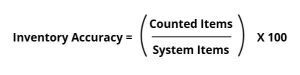
Anything below 95% indicates a breakdown in your warehouse processes. Frequent errors here suggest that items are being misplaced, stolen, or recorded incorrectly at the receiving dock.
4. Order Cycle Time
How long does it take from the moment a customer clicks “Buy” to the moment the package leaves your dock? High-efficiency inventory control reduces this time by ensuring items are easy to find and ready to ship. In the age of “Amazon-prime” expectations, this KPI directly impacts your customer retention.
5. Carrying Cost of Inventory
This includes the “hidden” costs of storage, such as utilities, warehouse labor, insurance, and the “opportunity cost” of having your money tied up. Most experts estimate carrying costs at 20% to 30% of your total inventory value. Reducing this by even a small margin can add thousands of dollars directly to your net profit.
6. Sell-Through Rate
Especially important for retail and e-commerce, this compares the amount of inventory received from a supplier against what is sold to customers. This is a vital part of your Inventory Analytics helping you decide which products are “stars” and which are “dogs” that should be discontinued.
The Role of Technology: From Spreadsheets to Intelligent AI

In the past, a warehouse manager with a clipboard and a pencil was the standard. Today, that approach is a recipe for disaster. As your business grows, the complexity of your stock grows exponentially. This is where technology shifts from being a “luxury” to an absolute necessity.
The Power of Inventory Analytics
Modern systems don’t just count boxes; they provide Inventory Analytics. This means the software looks at historical data to predict future trends. It can tell you, “Based on last year’s data, you will run out of this specific SKU in 12 days.” This allows you to transition from reactive counting to proactive planning, ensuring you never miss a sales opportunity due to a stockout.
Automated Inventory Allocation
If you sell products across multiple channels such as an online store, Amazon, and physical retail locations deciding where to send your limited stock is a challenge. Inventory Allocation technology automates this. It uses real-time demand data to “reserve” stock for your most profitable channels or your most loyal customers, ensuring that your inventory is always where it can generate the highest return.
Real-Time Tracking: Barcodes and RFID
Human error is the leading cause of inventory inaccuracies. By implementing barcode scanning or RFID (Radio Frequency Identification), you remove the “manual entry” step.
- Barcoding: Fast and affordable; every scan updates your system instantly.
- RFID: Allows for “bulk scanning.” You can scan an entire pallet of goods without opening a single box, providing unparalleled speed in Inventory Positioning in Supply Chain Management.
Cloud-Based Integration
The most successful companies use a “Connected Stack.” This means your inventory software talks directly to your accounting, shipping, and sales platforms. When a customer buys an item in Jakarta, your warehouse in Surabaya knows about it instantly. This level of synchronization is what allows a business to scale without the wheels falling off.
FAQ
What is the best method for inventory control?
There is no “one-size-fits-all” answer, but most successful businesses use a combination of ABC Analysis to prioritize items and Cycle Counting to maintain accuracy. The best method is one that provides real-time visibility and integrates with your sales channels.
How does inventory control improve cash flow?
By reducing the amount of “Dead Stock” and preventing over-ordering, you ensure that your capital isn’t tied up in unsold goods. This allows you to use that cash for other business needs like marketing or expansion.
Can small businesses benefit from Inventory Analytics?
Absolutely. Even basic Inventory Analytics can help a small business identify which products are seasonal and which are underperforming, preventing costly storage mistakes before they scale.
What is the difference between Inventory Allocation and Positioning?
Inventory Allocation is the process of deciding which sales channel or location gets specific stock, while Inventory Positioning refers to the physical placement of that stock within the supply chain to ensure the fastest delivery to the end customer.
Conclusion
Mastering inventory control is a continuous journey of balancing data, physical organization, and technology. By moving away from manual spreadsheets and embracing strategies like Cycle Counting and Inventory Analytics, you transform your warehouse from a simple storage room into a high-powered engine for growth. Remember, every unit saved from “aging” and every minute shaved off your “order cycle time” goes directly to your bottom line, giving you a massive edge in today’s competitive market.

Ready to take your operations to the next level? Efficiency starts with having the right tools to monitor, track, and optimize your stock in real-time. Explore our deep dives into advanced strategies and software solutions by browsing our latest insights under the TAG Samurai Inventory Management tag to start scaling your business with confidence today.

- Physical Asset Control to Improve Operations - 19/04/2026
- Asset Life Cycle Management for Cost Efficiency - 13/04/2026
- Asset Maintenance Strategy for Enterprise Growth - 07/04/2026

