

In the fast-paced market of 2026, waiting until the end of the month to know your stock levels is a risk. Modern businesses need answers instantly. This demand for speed has led to the widespread use of the Perpetual Inventory System. Unlike older methods, this system tracks every single movement of goods in real-time.
A perpetual system records sales, returns, and new purchases the moment they happen. It turns your warehouse into a living digital map. This constant flow of data is the backbone of modern Inventory Planning. It allows managers to make fast, data-driven decisions. You no longer have to guess how much stock is left on the shelf.
What is Perpetual Inventory?

Perpetual inventory is a method of accounting that tracks stock balances continuously. It updates records automatically after every transaction. Using tools like barcodes and RFID, it provides an immediate view of Stock Levels and cost of goods sold (COGS) without needing to stop operations for a count.
How Perpetual Inventory Works
The magic of a perpetual system lies in its constant synchronization. It creates a digital twin of your physical warehouse. Every time a product moves, the database updates. This process eliminates the “manual lag” found in traditional methods.
The Digital Paper Trail
The system relies on a continuous loop of data. Here is how the typical workflow functions:
- Receiving: When new stock arrives, staff scan the items using Barcode or RFID technology. The system instantly increases the Stock Levels in the database
- Sales and Dispatch: As items are sold or moved for shipping, the Point of Sale (POS) or Warehouse Management System (WMS) automatically deducts them
- Instant Calculation: The system re-calculates the remaining inventory value and the Cost of Goods Sold (COGS) in real-time
The Role of Physical Verification
Even with high-tech automation, a perpetual system is not perfect. Human errors, theft, or damage can still cause discrepancies. This is why a Physical Inventory count is still necessary. However, instead of closing the entire warehouse for a year-end audit, companies use “cycle counting.” This involves counting a small portion of stock every day to ensure the digital records match the physical reality.
Integration with Modern Hardware
A perpetual system works best when it communicates with your storage infrastructure. For instance, when Maximizing Space Utilization with Shuttle Racking, the system tracks exactly which pallet the shuttle has placed in which deep-lane position. This synergy between software and hardware ensures that your Stock Control is both accurate and physically optimized.
Strategic Benefits for Scaling Businesses

For a growing enterprise, data is the most valuable currency. Transitioning to a perpetual system offers competitive advantages that directly impact the bottom line. It moves the warehouse from a reactive state to a proactive one.
Immediate Visibility and Better Decisions
The most obvious benefit is having 24/7 access to your Stock Levels. You don’t have to wait for a scheduled audit to know if you can fulfill a large order. This real-time insight allows sales teams to commit to customers with 100% confidence. It also prevents the “panic buying” of stock that often happens when data is unclear.
Automated Reordering and Inventory Planning
A perpetual system is a game-changer for Inventory Planning. You can set “low-stock” triggers for every SKU. When an item reaches a specific threshold, the system can automatically generate a purchase order. This ensures you never miss a sale due to a stockout. It also keeps your capital from being tied up in excess inventory that you don’t need.
Enhanced Stock Control and Loss Prevention
Since every transaction is recorded, it is much easier to identify where stock goes missing. If there is a gap between your digital record and your Physical Inventory, you can pinpoint the exact day the discrepancy occurred. This high level of Stock Control acts as a deterrent for internal theft and helps identify flaws in your receiving process.
Optimized Warehouse Throughput
When combined with Maximizing Space Utilization with Shuttle Racking, a perpetual system maximizes speed. The software tells the shuttle exactly where to go. There is no searching for “lost” pallets in deep lanes. This efficiency allows you to process more orders in less time with the same number of staff.
Perpetual vs Periodic: The High-Stakes Comparison
Choosing the right system is a critical business decision. While both methods track inventory, they serve very different operational needs. Understanding the gap between them is vital for long-term success.
The Cost of “Waiting”
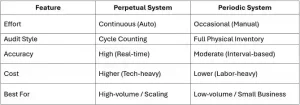
The primary difference lies in the frequency of data updates. A Periodic Inventory System only provides a snapshot at the end of a week or month. This creates a “data blackout” period. During this time, you cannot be sure of your exact Stock Levels. In contrast, a perpetual system gives you a live feed. This eliminates the guesswork that often plagues smaller operations.
Accuracy and Accountability
In a periodic setup, Stock Control is difficult. If an item is missing, you may not notice for weeks. With perpetual tracking, every movement has a digital signature. This makes it much easier to hold staff accountable and reduce shrinkage.
The Scalability Factor
A periodic system often fails as a business grows. If you are Maximizing Space Utilization with Shuttle Racking, you cannot afford to wait for a manual count. Automation and real-time data must go hand-in-hand. For any business aiming for high-efficiency Inventory Planning, the perpetual model is the clear winner for scalability.
Synergizing with Automated Hardware

To get the most out of modern technology, your software and hardware must “talk” to each other. This is especially true when Maximizing Space Utilization with Shuttle Racking. In a high-density warehouse, the physical complexity is high. You cannot manage deep-lane storage with a clipboard and a prayer.
Real-Time Location Tracking
A perpetual system acts as the “brain” for the shuttle racking hardware. When a shuttle moves a pallet, the system records its exact coordinate in the rack. This ensures that Stock Control is precise down to the specific lane and level. Without real-time data, pallets can easily be “lost” behind others in a 50-deep lane.
Speeding Up Fulfillment
Efficiency in a warehouse is measured by “travel time.” A perpetual system keeps your Stock Levels mapped digitally. This allows the system to send shuttles to the nearest available pallet instantly. This synergy slashes the time it takes to pick an order. It transforms your warehouse into a high-speed engine that can handle 2026’s demand for rapid delivery.
Reducing Human Intervention
When your inventory data is perpetual, the need for manual searching disappears. This reduces the number of workers needed on the floor. It also minimizes the risk of accidents. Automated hardware combined with real-time software creates a safer, faster environment. This is the ultimate goal of Inventory Planning in the age of automation.
Implementation Challenges: What No One Tells You
Transitioning to a perpetual system is a powerful move, but it is not without hurdles. It is a fundamental shift in how your business operates. You must be prepared for the technical and cultural changes that follow.
High Initial Investment
The first challenge is the cost. Unlike a Periodic Inventory System, which requires very little tech, a perpetual system demands an upfront investment. You need reliable software, barcode scanners, and perhaps RFID gates. For businesses already Maximizing Space Utilization with Shuttle Racking, this cost is usually seen as a necessary part of the automation package.
The “Garbage In, Garbage Out” Problem
A perpetual system is only as good as the data entered into it. If a staff member forgets to scan a pallet, the digital record becomes wrong instantly. This error then ripples through your Inventory Planning. Maintaining data integrity requires strict discipline. Every single movement returns, damages, or transfers must be recorded without exception.
The Need for Constant Power and Connectivity
Since the system runs in real-time, it relies heavily on your warehouse infrastructure. A Wi-Fi dead zone or a server crash can freeze your operations. Unlike manual Stock Control, you cannot easily switch back to paper if the system goes down. You must invest in robust network hardware and back-up systems to ensure 24/7 uptime.
Best Practices for Maintaining Data Integrity

A perpetual system is a powerful tool, but it requires “maintenance” to stay accurate. You cannot simply set it and forget it. To ensure your Stock Control remains sharp, you must adopt a culture of precision.
Adopt Cycle Counting
Even with real-time tracking, small errors happen. Instead of one massive yearly Physical Inventory count, use cycle counting. This means counting a small, different section of your warehouse every day. It ensures that your digital records and physical reality stay in sync without stopping operations.
Strict Employee Training
The biggest threat to data is human error. Every team member must understand that if it isn’t scanned, it doesn’t exist. Standardize the “receiving” and “shipping” workflows. When employees see how their scans affect Stock Levels and Inventory Planning, they are more likely to be diligent.
Invest in Durable Hardware
Warehouse environments are tough. Dust, drops, and temperature swings can kill cheap scanners. Use industrial-grade hardware that can handle the rigors of the floor. If you are Maximizing Space Utilization with Shuttle Racking, ensure your Wi-Fi signal reaches the furthest corners and highest levels of your racks.
FAQ
Is a perpetual system expensive to maintain?
The software often has a monthly fee, but the reduction in labor and errors usually pays for the system within the first year.
Does it replace the need for manual counts?
No. You still need a Physical Inventory count or cycle counts to find “hidden” issues like damage or theft.
What happens if the internet goes down?
Most modern systems have an “offline mode.” They store data locally and sync it once the connection returns.
Can I switch from a Periodic Inventory System easily?
Yes, but it requires a clean “starting count” and a commitment to scanning every transaction from that moment forward.
Conclusion
The shift to a Perpetual Inventory System is a defining moment for any modern warehouse. It provides the real-time heartbeat needed for high-speed logistics in 2026. By eliminating the “visibility gap,” you empower your team to perform better Inventory Planning. This system ensures your Stock Levels are always accurate and your Stock Control is unbreakable.
As we have seen, the combination of smart software and automated hardware is the future. When you pair perpetual data with solutions like Maximizing Space Utilization with Shuttle Racking, you create a warehouse that is both dense and fast. It is the most effective way to protect your margins and scale your business with confidence.
Master Your Inventory with Tag Samurai
Ready to stop guessing and start knowing? TAG Samurai Inventory Management is the ultimate partner for your perpetual inventory journey. Our platform offers the real-time tracking, automated alerts, and deep analytics you need to thrive. Whether you are running a traditional warehouse or a high-tech facility, Tag Samurai ensures your data is always 100% reliable.

Say goodbye to the headaches of manual counting and the risks of a Periodic Inventory System. Take control of your assets with a system designed for the modern age. Contact Tag Samurai today to discover how our solution can streamline your operations and maximize your ROI


