

In the world of logistics, your software might tell you one thing, but the warehouse shelves might say another. This gap between digital records and physical reality is where profits disappear. To fix this, businesses rely on a Physical Inventory count. This is the process of manually counting every item in stock to ensure your records are 100% accurate.
Conducting a physical audit is more than just a chore; it is the “moment of truth” for your operations. Whether you use a simple Periodic Inventory System or a high-tech Perpetual Inventory system, you cannot escape the need for a physical check. It validates your Stock Levels and ensures your financial statements are honest.
What is Physical Inventory? Physical inventory is a structured counting process where a business physically verifies the quantity and condition of all goods in its possession. It is used to reconcile digital records, calculate accurate tax values, and identify “shrinkage” caused by theft, damage, or administrative errors.
Why Physical Inventory is Non-Negotiable

Even with the most advanced automation, a disconnect between the digital record and the physical shelf is inevitable. Physical inventory acts as the ultimate filter for these discrepancies. Skipping this process is like trying to navigate with a map that hasn’t been updated in years; you might think you know where you are, but you’re likely headed for a dead end.
Detecting “Shrinkage” and Theft
One of the primary goals of a physical count is to identify shrinkage. Shrinkage is the loss of inventory due to theft, damage, or administrative errors. Without a physical check, these losses stay hidden in your books, inflating your assets and hiding security flaws. Strong Stock Control relies on knowing exactly when and where items go missing so you can improve warehouse security or handling procedures.
Financial and Tax Compliance
At the end of the fiscal year, your business must report the value of its inventory. If your Stock Levels are recorded incorrectly, your profit-and-loss statements will be wrong. This can lead to overpaying taxes or, worse, failing a financial audit. Physical inventory provides the documented proof required by tax authorities and investors, ensuring your business remains compliant and transparent.
Identifying Obsolete and “Dead” Stock
A physical count forces your team to look at every item. This is the best time to identify “dead stock”—items that are expired, damaged, or so outdated that they no longer sell. By clearing out this dead stock, you free up valuable room. This is a critical step in Maximizing Space Utilization with Shuttle Racking, as you don’t want high-tech shuttles moving pallets of unsellable goods.
Refining Future Strategy
The data gathered from an audit is a goldmine for Inventory Planning. If you consistently find that your physical count is lower than your digital record for a specific item, it signals a problem in the supply chain or the warehouse flow. You can use these insights to adjust your reorder points and safety stock levels for the coming year.
Physical Inventory in Different Systems

The way you conduct a physical count depends heavily on your underlying accounting method. While the physical act of counting is the same, the purpose and frequency change based on whether you are using a manual or a digital approach.
The Backbone of the Periodic Inventory System
In a Periodic Inventory System, physical inventory is not just a “check” it is the only way to determine your ending stock. Because this system does not track daily sales in a live database, you cannot calculate your Cost of Goods Sold (COGS) without a full physical count. For these businesses, the audit is a high-stakes event that usually happens at the end of a month or year. If the count is wrong, the entire financial report for that period is ruined.
The Verifier for Perpetual Inventory
For businesses using Perpetual Inventory, the physical count serves as a verification tool. Even though the system updates Stock Levels in real-time, human errors like “mis-scans” can still occur. Instead of one massive, exhausting audit, perpetual users often use Cycle Counting. This involves counting a small percentage of items every day. This keeps the data accurate year-round without ever needing to shut down the warehouse.
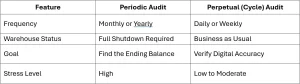
Regardless of the system, the goal remains the same: ensuring your Stock Control measures are actually working. Without the physical “anchor,” digital data can slowly drift away from reality, leading to poor Inventory Planning and lost revenue.
How to Conduct a Stress-Free Audit

A physical inventory count is often dreaded because it can be chaotic. However, with the right structure, it becomes a streamlined operation. To achieve 100% accuracy in your Stock Levels, you must follow a disciplined three-phase approach.
Phase 1: Preparation (The “Pre-Count”)
Success is decided before the counting even starts.
- Freeze Transactions: Stop all incoming and outgoing shipments. If items move while you count, your data will be useless.
- Organize the Space: Tidy up the aisles and ensure every pallet is labeled. If you are Maximizing Space Utilization with Shuttle Racking, ensure the shuttle system has finished its last cycle so all pallets are in their designated home positions.
- Define Zones: Divide the warehouse into specific zones and assign teams to each.
Phase 2: Execution (The “Count”)
This is where the physical labor happens.
- Use Digital Tools: Ditch the clipboards. Use barcode scanners or mobile apps that sync directly with your Perpetual Inventory software.
- The Two-Tag System: Use a “blind count” method where a second team recounts the same area without seeing the first team’s numbers. This is the best way to catch human errors.
- Identify Damages: While counting, flag any items that are broken or expired so they can be removed from your active asset list.
Phase 3: Reconciliation (The “Check”)
Once the counting is done, compare your physical numbers with your digital records.
- Investigate Gaps: If the physical count differs from your Stock Control data, find out why. Was a shipment never scanned? Is there evidence of theft?
- Update the System: Only after investigating should you adjust your official records. This ensures your Inventory Planning for the next quarter starts with perfect data.
Challenges in High-Density Warehousing

As warehouses become more advanced, the physical audit process becomes more complex. Traditional methods of walking down an aisle with a clipboard don’t work when you are Maximizing Space Utilization with Shuttle Racking. High-density systems are designed for storage efficiency, but they can create “visibility hurdles” during a physical count.
Accessing Deep-Lane Storage
In a shuttle racking setup, pallets are often stored 20 to 50 deep in a single lane. For a human counter, seeing the labels on the 30th pallet is physically impossible without moving everything. To maintain your Stock Control, you must rely on the shuttle’s on-board sensors and the system’s “Log History.” Modern warehouses use the shuttle to bring pallets forward for verification or use integrated drones to scan tags in deep lanes.
Vertical Complexity
Modern facilities utilize every inch of vertical space. When your Stock Levels are spread across racks reaching 15 meters high, safety becomes a primary concern during an audit. You cannot have staff climbing racks to verify a SKU. This is where the synergy with a Perpetual Inventory system is vital. The digital system tells you exactly what is at the top, and you only need to perform “spot checks” using lift equipment.
The Automation Paradox
The more automated your warehouse, the more you rely on digital accuracy. If the software makes a mistake in a high-density environment, it is harder to find than in a standard rack. This makes the Physical Inventory count even more important. It serves as a necessary “reset button” for the technology. It ensures that the robots and the records are both aligned with the physical reality of the floor.
Impact on Future Inventory Planning
A physical inventory count is not just about correcting the past; it is about securing the future. The data you collect during an audit is the “raw material” for smarter Inventory Planning. Without accurate physical data, your planning models are based on fiction, which can lead to costly overstocking or disastrous stockouts.
Improving Forecasting Accuracy
When you reconcile your physical count with your records, you often find patterns. Perhaps certain items always have a 5% discrepancy due to damage during handling. By identifying these trends, you can adjust your “Safety Stock” levels more accurately. This ensures that your Stock Levels are optimized to handle real-world conditions, not just perfect-world theories.
Optimizing Procurement Cycles
If a physical audit reveals that you have more of a specific SKU than your Perpetual Inventory system suggested, you can delay your next purchase order. This keeps cash in the business instead of sitting on a shelf. Conversely, if you find you are lower than expected, you can rush an order before a shortage hits your customers. This level of Stock Control is what separates profitable companies from those struggling with cash flow.
Designing Better Storage Strategies
Audit results can also show you how to better use your warehouse. If an audit shows that high-turnover items are being stored in hard-to-reach areas, you can reorganize. This is especially helpful when Maximizing Space Utilization with Shuttle Racking. You can move fast-moving pallets to the front of the lanes, reducing the work for your shuttles and speeding up your entire operation.
Best Practices for Accuracy
To ensure your physical count is more than just an “educated guess,” you must implement high-standard protocols. Accuracy during the audit prevents the need for a re-count, which can be expensive and demoralizing for your team.
Implement “Blind Counting”
Do not give your counters a sheet that shows the “expected” quantity from your Perpetual Inventory system. If they see “Expected: 50,” they are more likely to write down “50” without double-checking. By providing a blank count sheet, you force them to verify every single unit physically. This is the gold standard of Stock Control.
Utilize Specialized Teams
Consider using a “Tag Team” approach. The first team counts and places a physical tag on the rack; the second team follows behind to verify and pull the tag. This double-layer of verification is especially helpful when Maximizing Space Utilization with Shuttle Racking, where the density of items makes it easy to lose track of which pallets have been counted.
Audit the Audit
Assign a supervisor to perform “spot checks” on 5-10% of the counted areas. If the supervisor finds an error, the entire section must be recounted. This creates a culture of accountability and ensures that everyone takes the Physical Inventory process seriously.
FAQ
How often should we do a full physical inventory?
For most businesses, once a year is the minimum for tax purposes. However, those with high-volume turnover often benefit from quarterly counts.
Can we count while the warehouse is operating?
It is highly discouraged. Moving stock during a count leads to “double counting” or missing items entirely. If you must stay open, use the Cycle Counting method within a Perpetual Inventory system.
What is the most common error in physical counts?
Human fatigue and poor labeling. Ensure your team has enough breaks and that all SKUs are clearly marked before the count begins.
Conclusion
A Physical Inventory audit is the ultimate reality check for your business. It bridges the gap between what your computer says and what your customers will actually receive. By committing to regular, disciplined counts, you protect your profit margins and ensure that your Stock Levels are always optimized.
In the era of automated warehouses and high-speed logistics, physical accuracy is your greatest asset. Whether you are using a Periodic Inventory System or advanced tech like Maximizing Space Utilization with Shuttle Racking, the physical count remains the foundation of trust in your data. It is the only way to ensure your Stock Control is as strong as it can be.
Simplify Your Audits with Tag Samurai
Stop struggling with messy spreadsheets and lost tags. TAG Samurai Inventory Management makes your physical inventory process faster and more accurate than ever before. Our mobile scanning solutions allow your team to record counts in real-time, automatically reconciling them with your digital records.


