

In the world of industrial operations, the word “maintenance” often conjures up images of a technician with a wrench, rushing to fix a broken pipe or a stalled conveyor belt. This reactive view is a significant part of the story, but it is far from the whole picture. To achieve world-class efficiency, a business must look beyond merely keeping the lights on. Maintenance is a spectrum that ranges from restoring what was lost to optimizing what currently exists.
Mistaking one for the other can lead to massive inefficiencies. If you only focus on correction, you will constantly be “running to stand still.” If you ignore the need for correction in favor of perfection, your infrastructure will crumble under the weight of unresolved failures. This article will break down these two pillars, helping you find the balance that secures both reliability and continuous improvement.
What is Corrective Maintenance?
Corrective maintenance is the most familiar form of maintenance work. Its primary objective is to identify, isolate, and rectify a fault so that the failed equipment, machine, or system can be restored to its operational condition within the requirements established for normal operation. In the broader scope of asset maintenance, this is the “recovery” mechanism.
The “Reaction” Strategy
At its core, corrective maintenance is reactive. It occurs after a problem has been detected—whether that problem is a total system shutdown or a minor decrease in performance that doesn’t meet the baseline. However, not all corrective maintenance is an “emergency.” It can be categorized into two types:
- Planned Corrective Maintenance: You detect a fault (e.g., a slightly frayed belt), but the machine is still running. You schedule the repair for a later time when it won’t disrupt production.
- Unplanned (Emergency) Corrective Maintenance: The asset fails suddenly, and immediate action is required to bring it back online.
Connection to Crisis and Checklists
When a sudden failure occurs, the pressure on the maintenance team is immense. This is where having a standardized breakdown maintenance checklist becomes a lifesaver. Without a checklist, corrective actions often become chaotic, leading to safety risks or “quick fixes” that don’t address the actual problem.
The Necessity of Correction
No matter how advanced your facility is, you cannot eliminate corrective maintenance entirely. Components will always have random failures or wear out in ways that sensors might miss. Understanding the importance of breakdown maintenance for critical assets means accepting that a percentage of your budget must always be allocated to these “restorative” acts. The goal isn’t to reach zero corrective maintenance, but to ensure that when you do it, it is handled efficiently, safely, and documented thoroughly to prevent a repeat performance.
What is Perfective Maintenance?
While corrective maintenance is about looking backward to fix what broke, Perfective Maintenance is about looking forward. It is the practice of modifying an asset to improve its performance, enhance its maintainability, or increase its functional capacity even if the asset is currently working perfectly. In the context of asset maintenance, this is the “evolutionary” phase.
The “Optimization” Strategy
The goal of perfective maintenance is not to fix a fault, but to eliminate the possibility of future faults or to make the machine better than it was on day one. It is often triggered by feedback from operators or data analysis. If a technician notices that a specific pump is difficult to reach for lubrication, they might install an automatic greasing system. The pump wasn’t broken, but the modification makes the asset “more perfect” for the environment it operates in.
Contrast to Routine Care
It is easy to confuse this with what is preventive maintenance. However, the distinction is clear:
- Preventive Maintenance replaces a part to keep the machine at its original standard.
- Perfective Maintenance changes the system to raise that standard.
Real-World Examples of “Perfection”
- Software Upgrades: Updating a PLC (Programmable Logic Controller) to a newer firmware version that processes data faster or has better security.
- Structural Improvements: Adding better insulation to a furnace to reduce heat loss and save on energy costs.
- Material Upgrades: Replacing standard steel bolts with titanium or stainless steel in a corrosive environment to extend the time between service intervals.
Purpose, Timing, and Impact
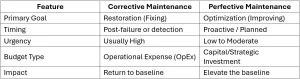
To manage a facility effectively, you must understand that Corrective and Perfective maintenance operate on different timelines and with different financial motivations. While both are necessary components of asset maintenance, they impact your operational workflow in distinct ways.
Motivation: Problem vs Opportunity
The most striking difference lies in the “trigger.” Corrective maintenance is triggered by a problem a failure, a leak, or an alarm. It is a mandatory response to a negative event. Perfective maintenance, however, is triggered by an opportunity. It is a voluntary choice to improve a system based on observed data or new technology.
Cost Structure and Planning
Corrective maintenance is often expensive because it is unpredictable. When a machine fails, you pay for emergency labor, rushed shipping for parts, and the massive cost of lost production. On the other hand, perfective maintenance allows you to learning how maintenance scheduling cuts costs and time. Because it isn’t urgent, you can wait for the best prices on parts and schedule the work during a period where it won’t affect your revenue.
Impact on Downtime
Downtime in corrective maintenance is “forced.” It stops the line regardless of your deadlines. Perfective maintenance aims to reduce future downtime. In fact, many perfective upgrades are suggested after analyzing how predictive maintenance reduces downtime and costs. For example, if predictive data shows that a motor is struggling with high loads, a perfective upgrade to a higher-torque motor can prevent future failures entirely.
Resource Allocation
In a corrective scenario, you are at the mercy of the machine. In a perfective scenario, you are the master of your resources. By allocating a specific portion of your labor hours to “perfection” projects, you slowly reduce the number of “correction” emergencies your team has to face.
Choosing the Right Balance
In the world of asset maintenance, you can’t have one without the other, but you also can’t pursue both with equal intensity at all times. Finding the “Golden Ratio” between corrective and perfective actions is what separates profitable operations from those that are merely surviving.
The Rule of Diminishing Returns
While perfective maintenance sounds ideal, there is a point of diminishing returns. Over-engineering a machine that is already performing at 98% efficiency might cost more in labor and parts than the 2% gain is worth. Management must evaluate perfective projects based on a clear Cost-Benefit Analysis (CBA). If the upgrade doesn’t significantly lower the risk profile found in your breakdown maintenance checklist or provide a measurable boost in output, it may be better to leave it as is.
Prioritizing Based on Asset Criticality
Not all assets deserve “perfection”.
- Critical Assets: These should be the focus of perfective maintenance. Since these are “bottlenecks,” any upgrade that increases speed or reduces service time is a massive win. This aligns with the importance of breakdown maintenance for critical assets the less time they spend in a corrective state, the better.
- Secondary Assets: For non-essential equipment, a simple corrective strategy (running it until it needs a minor fix) is often the most financially sound approach.
The Goal: A Lean Maintenance Mix
A world-class facility typically aims for a mix where 80% of activities are proactive (Preventive, Predictive, and Perfective) and only 20% are corrective. By consciously shifting 5% to 10% of your corrective budget toward perfective upgrades each year, you create a “compounding interest” effect on your operational reliability.
FAQ
Is perfective maintenance the same as “upgrading”?
In many ways, yes. While the term “upgrade” is often used for software, perfective maintenance applies to physical modifications that make a machine better, faster, or easier to maintain. It is the act of evolving an asset beyond its original factory specifications.
Why should I spend money on perfective maintenance if the machine isn’t broken?
Because “not broken” doesn’t mean “efficient.” If a breakdown maintenance checklist shows that a machine fails every month due to heat, a perfective upgrade to its cooling system will save you thousands in future repair costs and lost production time.
Does perfective maintenance count as “Preventive Maintenance”?
No. To understand the nuances, you can look at what is preventive maintenance and examples. Preventive care is about keeping things the same; perfective care is about making things better.
Can perfective maintenance be done during a corrective repair?
Absolutely. This is often the most efficient time to do it. If you are already tearing down a machine to fix a broken gear (Corrective), replacing it with a high-performance, long-life gear (Perfective) is a smart way to save big by learning how maintenance scheduling cuts costs and time.
How do I justify the cost of “perfection” to my management?
Focus on the ROI. Show how the modification reduces energy consumption, cuts labor hours for routine service, or eliminates a recurring failure identified in your asset maintenance logs.
Conclusion
The difference between perfective and corrective maintenance is the difference between being a leader or a follower in your industry. Corrective maintenance is a necessary reaction to the reality of wear and tear, ensuring that when things go wrong, you have the tools to bring them back to life. Perfective maintenance, however, is a strategic choice. It represents a commitment to continuous improvement, ensuring that your facility doesn’t just stay operational, but becomes more competitive every year.
By balancing the restorative power of corrective actions with the visionary goals of perfective upgrades, you create a robust asset maintenance ecosystem. This balance ensures that your critical equipment is always performing at its peak, reducing the frequency of emergencies and maximizing the value of every dollar spent on your workshop floor.
However, neither strategy works without the right parts and tools on hand. To execute a perfective upgrade or a corrective repair, you need absolute visibility into your stock levels. TAG Samurai Inventory Management is designed to bridge the gap between maintenance planning and spare parts availability. Never let an upgrade be delayed or a repair be stalled because of a missing bolt.


- First in First Out: Why This Queuing Matters - 04/05/2023
- The Importance of Safety Stock for Inventory Systems - 02/05/2023
- how should stock be stored for Maximum Efficiency - 01/05/2023

