

For decades, the “Annual Physical Inventory” was a dreaded ritual in the warehousing world. Businesses would shut down operations for an entire weekend, pay massive amounts of overtime, and deploy every available staff member to count every single item in the building. By the time the audit was finished, the data was already starting to decay, and the operational downtime had already cost the company thousands in lost sales. In today’s fast-paced, “always-on” economy, this reactive approach is no longer sustainable. Enter Inventory Cycle Counting.
Cycle counting is a modern, proactive alternative that replaces the massive year-end audit with small, frequent, and highly targeted counts. Instead of counting everything once a year, you count a small portion of your stock every day or every week. This ensures that your records remain accurate year-round without ever needing to pause your business operations.
Why Your Business Needs It

Transitioning to a cycle counting program isn’t just about administrative convenience; it is a strategic move that affects every layer of the supply chain. By maintaining a continuous pulse on your stock, you eliminate the “surprises” that typically haunt warehouse managers during year-end audits.
1. Operational Continuity
The most immediate benefit is the elimination of downtime. In a traditional annual count, shipping and receiving must stop to ensure a “frozen” snapshot of the inventory. This halts revenue and disrupts customer service. Cycle counting happens in the background of daily operations. You can audit a specific rack or a high-value SKU in the morning and continue shipping orders by the afternoon.
2. Rapid Error Detection and Root Cause Analysis
When you count once a year, an error found in December might have happened in February. At that point, it is impossible to trace why it happened. With cycle counting, if a discrepancy is found, it likely occurred within the last few weeks. This allows managers to investigate immediately was it a scanning error, a picking mistake, or a theft? Detecting these patterns early allows for a tighter Inventory Control framework.
3. Improved Accuracy and Financial Integrity
Consistently high inventory accuracy (often reaching 97% or higher with cycle counting) translates directly to the balance sheet. It reduces the need for massive “write-offs” at the end of the fiscal year, which can devastate profit margins. Furthermore, accurate data prevents the onset of Inventory Aging, as the counting process often uncovers forgotten stock or items that are nearing their expiration date.
4. Optimized Customer Experience
There is nothing more damaging to a brand than a “ghost inventory” scenario: a customer buys a product online, only for the company to realize later that the physical stock doesn’t exist. Cycle counting ensures that what is visible on your e-commerce platform matches what is sitting in the warehouse. This reliability reduces order cancellations and increases customer trust.
5. Increased Staff Efficiency
Instead of a chaotic, all-hands-on-deck audit once a year, cycle counting allows for a dedicated, trained team to handle audits professionally. This team becomes highly efficient at identifying SKU variations and utilizing scanning technology, leading to more reliable results than a group of temporary workers or exhausted staff trying to count an entire warehouse in 48 hours.
Cycle Counting Methods: Choosing the Right Approach

Not every item in your warehouse carries the same weight in terms of value or risk. Therefore, a “one-size-fits-all” approach to auditing is rarely efficient. To maximize the impact of your efforts, you must choose a cycle counting method that aligns with your specific operational goals.
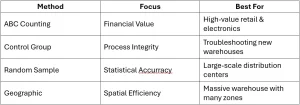
1. ABC Cycle Counting (The Value-Driven Approach)
This is the most popular method and is deeply rooted in the principles of Inventory Analysis. In this model, you categorize items based on their Pareto impact (80/20 rule):
- Category A: High-value or high-velocity items (top 20%). These are counted most frequently (e.g., once a month)
- Category B: Moderate value/velocity (30%). These are counted quarterly
- Category C: Low-value or slow-moving items (50%). These are counted once or twice a year. By focusing your energy on “A” items, you protect the majority of your inventory value with the least amount of labor
2. Control Group Counting
This method focuses on a small group of items that are counted repeatedly over a short period. The goal isn’t just to verify the count, but to test the accuracy of the process itself. If the control group consistently shows discrepancies, it indicates a systemic failure in how items are being received, moved, or logged. Once the process is fixed for the control group, the method is expanded to the rest of the warehouse.
3. Random Sample Counting
If your warehouse has a large number of similar items, you may choose to audit a random selection of SKUs daily. This prevents staff from “preparing” for a count and provides a statistically valid snapshot of the overall warehouse accuracy. It is a highly effective way to identify broad issues in Inventory Control without focusing on specific high-value targets.
4. Geographic or Location-Based Counting
In this method, counters move through the warehouse systematically by aisle, rack, or bin. This is particularly useful for large facilities where minimizing travel time for the counting staff is a priority. It is often combined with other methods to ensure that “blind spots” in the warehouse such as top-shelf overflow areas are not ignored for too long.
Method Comparison Table
5. Diminishing Population Counting
This is a “check-the-box” method where you count a certain number of SKUs until every item in the warehouse has been counted exactly once within a set period (e.g., a year). Once a SKU is counted, it is removed from the “to-be-counted” list until the next cycle begins. This ensures 100% coverage, though it may lack the strategic focus of the ABC method.
How to Execute a Successful Cycle Count

A cycle count is only effective if it follows a disciplined, repeatable process. Simply walking into a warehouse and counting boxes will lead to “reconciliation nightmares” if the data isn’t handled correctly. To ensure the highest levels of integrity, follow these four critical steps.
Step 1: Preparation and “Freezing”
Before the physical count begins, you must ensure that all pending transactions such as sales orders, receipts, and internal transfers are fully processed in the system. While you don’t need to shut down the warehouse, you do need to “freeze” the specific bin or SKU being counted. If a picker removes an item while you are counting it, your variance report will be inaccurate.
Step 2: Execution (The Physical Count)
The actual count can be performed in two ways:
- Blind Counts: The counter is given a list of locations but not the “expected” quantity. This forces them to count every item manually rather than just agreeing with the screen.
- System-Guided Counts: The counter uses a mobile device or barcode scanner that guides them to the location. This is significantly faster and reduces human error in SKU identification, especially when managed through a robust Inventory Control platform.
Step 3: Investigation and Root Cause Analysis
If the physical count doesn’t match the system record, don’t just “fix the number.” You must investigate the Variance.
- Is the missing stock in the wrong bin?
- Was a recent shipment received but not scanned?
- Is there evidence of “shrinkage” (theft or damage)? Investigating the why is the only way to prevent the error from happening again next week.
Step 4: Reconciliation and Data Update
Once the discrepancy is explained (or exhausted), the final step is to reconcile the records. The system is updated to reflect the physical reality. This ensures that your next Inventory Analysis report is based on “ground truth,” allowing for more accurate financial reporting and procurement planning.
Common Challenges & How to Overcome Them
Implementing a cycle counting program is strategically sound, but it is not without its hurdles. Understanding the common friction points in a warehouse environment is the first step toward building a resilient auditing system.
1. The “Inventory in Motion” Dilemma
The biggest technical challenge is counting stock while the warehouse is active. If an item is being moved from receiving to a storage bin or is currently sitting in a picking cart the counter may record a discrepancy that doesn’t actually exist.
2. Inconsistent Scheduling
In many warehouses, cycle counting is treated as a “filler” task. When the facility gets busy, the audit is the first thing to be ignored. This leads to massive data decay over time.
3. Human Error in Manual Entry
Even the most diligent employee can miscount a stack of 50 items or mistype a SKU number into a spreadsheet. Manual data entry is the leading cause of “false variances”.
4. Overlooking the “Why”
Teams often rush through the reconciliation phase just to make the numbers match. If you adjust the inventory level without finding the root cause, you are merely treating the symptom while the “disease” (process failure) continues to cost you money.
Best Practices & The Role of Technology
To transition from a basic counting routine to a world-class auditing system, businesses must marry disciplined culture with modern technology. It is no longer enough to just “count”; you must count with intelligence and speed.
1. Zero-Tolerance for Unexplained Variances
A best-in-class cycle counting program doesn’t just adjust the numbers; it mandates a “deep dive” into any variance that exceeds a specific value threshold. By establishing a culture of accountability, staff become more diligent in their daily Inventory Control tasks, knowing that every discrepancy will be scrutinized.
2. Leverage Mobile and Cloud Technology
The era of the “clipboard and pen” is over. High-performance warehouses utilize mobile devices that provide real-time validation. If a worker scans the wrong SKU, the system alerts them immediately, preventing the error from ever entering the database. Cloud-based platforms ensure that as soon as a count is verified, the data is updated across all departments, from sales to procurement.
FAQ
How does inventory positioning differ from inventory allocation?
While they are closely related, positioning is the long-term strategic decision of where to place stock within a network (e.g., a regional hub vs. a local store). Conversely, Inventory Allocation is the tactical execution of moving specific quantities to those locations based on immediate demand.
What is “Postponement” in inventory positioning?
This is a strategy where products are kept in a centralized location in a generic state and only moved or customized once a firm order is received. Consequently, this reduces the risk of having the wrong stock in the wrong place.
Can small businesses benefit from decentralized positioning?
Absolutely. Even without multiple warehouses, a small business can use “Third-Party Logistics” (3PL) to position stock closer to high-density customer zones. As a result, they can compete with larger retailers on delivery speed.
Conclusion
Inventory Cycle Counting is more than just a warehouse chore; it is the heartbeat of a healthy supply chain. By moving away from the disruptive and often inaccurate annual audit, businesses can maintain “real-time” truth in their data. This constant accuracy is the fuel that powers advanced Inventory Analysis and ensures that your Inventory Allocation strategies are based on reality, not guesswork.

In a world where customer expectations are higher than ever, you cannot afford to have “ghost inventory” or missing stock. Implementing a structured cycle counting program supported by a robust system like TAG Samurai Inventory Management ensures that your warehouse remains transparent, accountable, and ready for growth. Stop guessing what’s on your shelves and start knowing


