

In the traditional landscape of logistics, businesses often focused exclusively on the volume of their stock. However, in the modern, hyper-competitive market, the question of where you hold your stock has become just as critical as how much you possess. This strategic shift is known as inventory positioning, and it represents the difference between a profitable supply chain and one plagued by excessive shipping costs.
Initially, most companies utilized a centralized model, keeping all goods in one massive warehouse to simplify management. Nevertheless, the “Amazon Effect” has fundamentally changed customer expectations, meaning that consumers now demand near-instant fulfillment. Consequently, businesses are moving away from centralized giants in favor of decentralized micro-hubs located closer to urban centers.
What is Inventory Positioning?

At its core, inventory positioning is a balancing act between two competing priorities: minimizing operational costs and maximizing customer service levels. To find the “sweet spot,” businesses must decide whether to position their stock upstream (closer to the manufacturer) or downstream (closer to the end consumer).
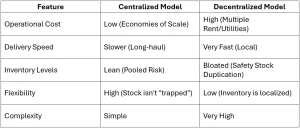
On one hand, keeping stock upstream allows for greater flexibility. Since the inventory is held in a central location, it hasn’t been committed to a specific market yet. Consequently, you can respond to demand spikes anywhere in the country without having stock “trapped” in the wrong region. This centralized approach significantly reduces holding costs because you only need one set of safety stock to cover the entire network. However, the obvious downside is increased shipping time and higher freight expenses when a customer finally places an order.
On the other hand, positioning stock downstream right in the backyard of your customers—dramatically improves fulfillment speed. By placing items in regional distribution centers, you effectively shorten the “lead time” for the user. Furthermore, this strategy can lower total transportation costs for high-velocity items, as bulk shipments to a regional hub are cheaper than hundreds of individual long-distance packages. Nevertheless, decentralized positioning increases the risk of Inventory Aging. If a specific region’s demand slows down, the stock sitting in that local hub may become obsolete or expire before it can be sold.
Centralized vs Decentralized Models: A Comparative Study
Choosing between a centralized and a decentralized model is perhaps the most significant structural decision a supply chain manager will face. Each model offers a distinct set of advantages, but they also come with unique challenges that can impact the bottom line. Consequently, most modern enterprises are now moving toward hybrid structures that attempt to capture the best of both worlds.
The Case for Centralized Positioning
In a centralized model, the company maintains its inventory in a single, large-scale facility or a very small number of regional hubs. Initially, this is the most cost-effective way to manage stock because it allows for “Safety Stock Pooling.” Instead of keeping a buffer in ten different locations, you keep one larger buffer at the center. As a result, the total amount of inventory required to maintain high service levels is significantly lower. Moreover, centralized facilities benefit from economies of scale regarding warehouse management systems, specialized labor, and security protocols.
The Case for Decentralized Positioning
Conversely, the decentralized model focuses on geographic dispersion. By spreading inventory across a wide network of smaller “spoke” warehouses or retail backrooms, a business can achieve lightning-fast delivery times. Furthermore, this model offers higher resilience. If one local warehouse experiences a power outage or a labor strike, the rest of the network continues to function. However, this speed comes at a price. Operating multiple small sites leads to higher overhead costs, duplicated safety stock, and a more complex Inventory Control environment.
The Hybrid “Hub and Spoke” Approach
Because neither model is perfect for every SKU, many organizations have adopted a hybrid “Hub and Spoke” strategy. In this scenario, slow-moving or expensive items remain in a central “Hub,” while fast-moving, high-demand products are pushed out to local “Spokes.” Consequently, the company can offer 24-hour delivery on its most popular items while keeping the rest of its catalog cost-efficiently centralized.
Ultimately, the choice between these models shouldn’t be static. Instead, it should be a dynamic decision based on evolving market trends. For instance, during a peak holiday season, you might temporarily decentralize your top-sellers to ensure they are within a two-hour drive of major customer clusters. By doing so, you maintain a competitive edge without permanently increasing your fixed overhead costs.
Variables Influencing Positioning Decisions

Determining exactly where to place your products is not a matter of guesswork rather, it is a calculated decision based on several volatile factors. Because market conditions change rapidly, managers must constantly evaluate these variables to ensure their positioning strategy remains optimal. Consequently, understanding the following four pillars is essential for any supply chain leader.
1. Demand Volatility and Predictability
Predictability is the primary driver of positioning logic. If an item has stable, predictable demand across all regions, it is a prime candidate for decentralized positioning. On the contrary, products with highly “lumpy” or unpredictable demand are much safer in a centralized hub. By keeping volatile items centralized, you avoid the risk of having a massive surplus in one city while facing a stockout in another. Furthermore, leveraging Inventory Analytics allows you to identify these patterns before they lead to costly mistakes.
2. Product Characteristics: Bulk, Value, and Perishability
The physical nature of the goods often dictates their placement. For instance, low-value but heavy items (like bottled water) must be positioned near the consumer because the cost of long-distance shipping would exceed the product’s profit margin. Conversely, high-value, lightweight items (securities or high-end electronics) can remain centralized since shipping costs represent a tiny fraction of their value. Additionally, perishable goods must be positioned downstream to minimize transit time and reduce the risk of spoilage.
3. Geographical “Clustering” of Customers
Where are your buyers actually located? If 70% of your sales occur in a specific coastal region, it makes little sense to keep the majority of your stock in a mid-continent warehouse. Instead, you should position your inventory in “clusters” that mirror your sales data. Nevertheless, you must also account for seasonal shift, for example, demand for winter gear will migrate geographically as the seasons change, requiring a dynamic shift in your stock placement.
4. Supplier Proximity and Lead Times
Finally, you must consider the “Upstream” side of the equation. If your primary manufacturer is in Southeast Asia, positioning your main distribution center near a major West Coast port can significantly reduce your initial lead time. However, if you have multiple suppliers across different continents, a more centralized “inland” hub might be necessary to consolidate incoming shipments. Ultimately, the goal is to create a seamless flow from the supplier’s factory to the customer’s front door with as few pauses as possible.
Implementation: Moving from Theory to Execution

Once the strategic variables are understood, the focus must shift toward the practical execution of the positioning plan. Initially, this requires a comprehensive “Data Mapping” exercise to visualize how stock currently moves through your network. By identifying where bottlenecks occur, you can pinpoint exactly where inventory is being held up. As a result, you can begin to relocate stock to more strategic nodes that align with actual customer demand.
Furthermore, successful implementation relies heavily on the process of Inventory Allocation. Positioning is the “plan,” but allocation is the “action.” Once you decide that a regional hub should hold 30% of your electronics, you must execute the physical transfer and digital logging of those goods. However, this is not a one-time event. Instead, modern supply chains require “Dynamic Re-balancing.” If sales in the southern region suddenly outpace the north, you must be able to shift stock between spokes quickly. Consequently, having a flexible logistics partner or an internal fleet is essential for maintaining this fluidity.
In addition to physical movement, risk mitigation must be a priority during the rollout. Managers often fall into the trap of “Over-Positioning,” where they spread inventory too thin across too many locations. Ultimately, this leads to fragmented stock and increased management complexity. Therefore, it is crucial to start with your high-velocity items first. By proving the success of decentralized positioning with a small subset of SKUs, you can build a scalable framework that can eventually be applied to the rest of your catalog.
Moreover, you must establish clear communication channels between the central hub and regional spokes. Otherwise, local managers might begin over-ordering stock, leading to a “Bullwhip Effect” where inventory levels become bloated and unmanageable. By doing so, you ensure that every node in your network is operating with a single version of the truth, allowing for a lean and responsive distribution system.
Technology: The Backbone of Multi-Site Visibility
In a decentralized or hybrid network, physical distance creates a natural barrier to transparency. Consequently, technology serves as the vital bridge that connects disparate locations into a single, cohesive system. Without real-time visibility, a manager in the central hub would have no way of knowing if a regional spoke is running low on stock or if a shipment has been delayed. Therefore, implementing a cloud-based management platform is no longer optional; it is a fundamental requirement for modern positioning.
Furthermore, this is where a solution like TAG Samurai becomes indispensable. By providing a “Single Pane of Glass” view, it allows stakeholders to track assets across multiple warehouses, retail stores, and even transit vehicles simultaneously. As a result, decision-makers can spot imbalances in the network instantly. For instance, if the system detects a surplus in Warehouse A and a shortage in Warehouse B, it can trigger an automated alert to initiate re-balancing.
In addition, maintaining strict Inventory Control is significantly easier when every site follows the same digital protocol. Automated barcode scanning and RFID integration ensure that as stock moves between nodes, the data remains 100% accurate. Ultimately, technology transforms inventory positioning from a static logistical plan into a dynamic, living strategy. By doing so, businesses can achieve the elusive goal of “Total Network Visibility,” ensuring that every item is accounted for, regardless of its physical coordinate in the world.
FAQ
How does inventory positioning differ from inventory allocation?
Initially, it may seem they are identical however, positioning is the long-term strategic plan of where to place stock, while Inventory Allocation is the tactical move of shipping specific quantities to those spots.
What is “Postponement” in this context?
This is a strategy where goods are kept in a central hub and only customized or moved once an order is confirmed. Consequently, this reduces the risk of having specialized stock stuck in the wrong region.
Can small businesses use decentralized positioning?
Yes, they can. For instance, by utilizing Third-Party Logistics (3PL) providers, a small company can position stock globally without owning warehouses. As a result, they can compete on speed with industry giants.
Conclusion
Ultimately, strategic inventory positioning is the final bridge between operational efficiency and customer satisfaction. By moving away from rigid, centralized structures in favor of dynamic, data-driven networks, your business can significantly reduce lead times and lower “last-mile” expenses. Furthermore, when this strategy is underpinned by the accuracy of Inventory Cycle Counting and the rigor of Inventory Control, your supply chain becomes a formidable competitive weapon. Therefore, the goal is no longer just to have enough stock, but to have it in the exact geographic location where it provides the most value.

To achieve this level of precision, you need a system that offers total visibility across all your distribution nodes. Consequently, we invite you to explore how TAG Samurai Inventory Management can transform your multi-site operations. By providing real-time data and automated tracking, Tag Samurai empowers you to position your inventory with absolute confidence and scale your business without the traditional logistical headaches.


